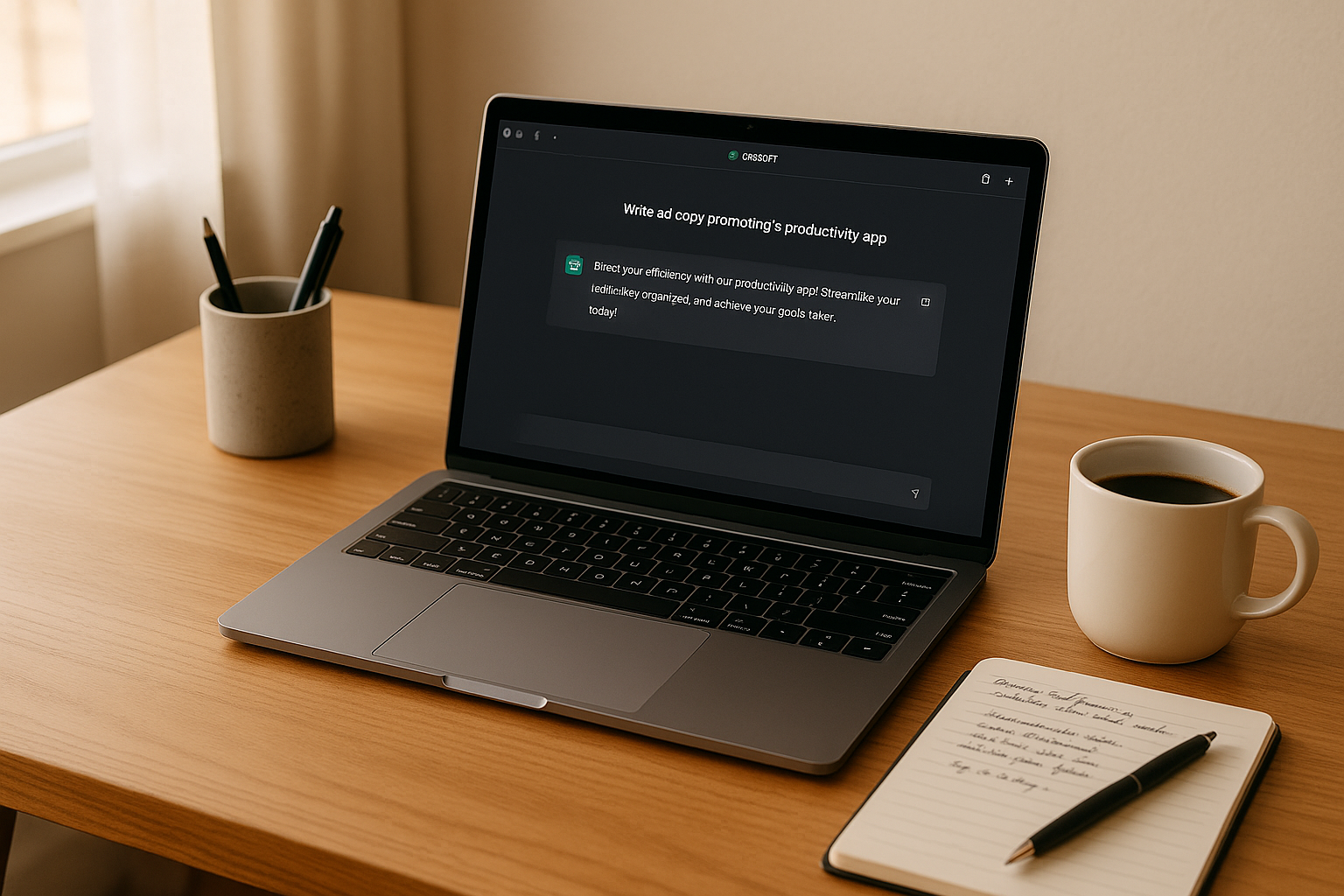
Creating ad copy that grabs attention and drives results can be challenging. ChatGPT simplifies this by generating tailored, high-quality ad content for various platforms. Here’s how you can use it effectively:
- Why It Matters: Good ad copy saves time, reduces costs, improves clarity, and boosts conversions.
- Key Features of ChatGPT:
- Generates multiple ad variations quickly.
- Adapts to different platforms and audiences.
- Produces headlines, body text, and calls-to-action aligned with your brand voice.
- Crafting Effective Prompts:
- Define ChatGPT’s role (e.g., “Act as a senior copywriter”).
- Provide clear context, objectives, and examples.
- Use proven frameworks like AIDA (Attention, Interest, Desire, Action) or PAS (Problem, Agitate, Solution).
- Platform-Specific Tips:
- For Facebook: Include primary text, headlines, and descriptions.
- For Instagram: Focus on visuals, captions, and hashtags.
- For Google Ads: Stick to strict character limits and integrate keywords.
Quick Comparison of Ad Copy Styles by Platform
| Platform | Text Elements | Character Limits | Key Focus |
|---|---|---|---|
| Primary Text, Headline | 125 (text), 40 (headline) | Strong CTAs, dynamic fields | |
| Captions, Carousel Text | 125 (carousel text) | Visuals, hashtags, swipe-up links | |
| Google Ads | Headlines, Descriptions | 30 (headline), 90 (desc) | Keywords, pricing, ad extensions |
How To Write Winning Ads Using ChatGPT in 2024 (Facebook & Google Ads)
Building Strong ChatGPT Prompts
Crafting effective prompts is the key to generating high-quality ad copy with ChatGPT. By including specific components and using proven frameworks, you can guide ChatGPT to produce diverse and engaging ad content.
Parts of an Effective Prompt
For a ChatGPT prompt to deliver strong ad copy, it needs six essential elements:
- Role Assignment: Define ChatGPT's role clearly (e.g., "Act as a senior copywriter for B2B software marketing").
- Context Setting: Provide campaign details, target audience demographics, and industry-related specifics.
- Clear Objectives: Specify the desired outcomes, such as boosting click-through rates, increasing sales, or raising brand awareness.
Here’s a quick reference table to illustrate these components:
| Prompt Component | Example |
|---|---|
| Role | "Expert Google Ads copywriter with 10+ years experience" |
| Context | "Targeting millennial parents concerned about sustainability" |
| Objective | "Generate 3 headlines that drive free trial signups" |
| Output Format | "Headlines ≤30 chars, descriptions ≤90 chars" |
| Constraints | "Avoid industry jargon and technical terms" |
| Examples | "Reference our top-performing ad: [example]" |
Once these elements are in place, you can apply proven ad copy frameworks to structure the content effectively.
Standard Ad Copy Structures
Using established frameworks like AIDA (Attention, Interest, Desire, Action) can significantly improve ad performance. For example, ads structured with AIDA have been shown to increase click-through rates by 23%.
AIDA Framework Prompt Example:
"Create a Google Search ad using AIDA: Begin with a shocking statistic about plastic waste (Attention), explain biodegradable packaging benefits (Interest), highlight convenience features (Desire), and end with a limited-time discount (Action). Use headlines ≤30 characters."
Another effective framework is PAS (Problem-Agitate-Solution). This structure works particularly well for direct response campaigns. Grammarly, for instance, saw a 34% increase in Facebook ad conversions by using PAS-based prompts.
Sample Prompts for Different Goals
Prompts can also be tailored to fit specific advertising objectives. Here are a few examples:
Brand Awareness:
"Generate 3 Instagram carousel concepts highlighting our solar-powered charger’s environmental impact, using nature imagery and climate change statistics from 2024".
Direct Response:
"Write a 120-character Google Ads text promoting 25% off seasonal tires, including urgency ('48-hour sale') and social proof ('Recommended by 9/10 mechanics')".
HubSpot’s multi-step prompting method illustrates the power of refining prompts to achieve better results. By generating broad headline ideas, filtering for emotional triggers, incorporating urgency, and testing variations, they achieved a 41% higher CTR on Google Ads.
Platform-Specific Prompt Writing
Every platform has its own style and rules, so crafting prompts that align with these specifics is key. While the core strategies remain the same, tailoring your prompts to fit each platform's unique requirements can make all the difference.
Social Media Ad Prompts
When creating prompts for social media ads, you need to consider each platform's character limits, formatting, and engagement style. Here's how you can approach some of the most popular platforms:
For Facebook Ads, prompts should include multiple text elements to fit the platform's structure:
"Write Facebook ad copy: primary text (125 characters), headline (40 characters), description (30 characters). Target audience: tech-savvy professionals aged 25-45. Include a strong call-to-action and highlight our AI-powered features. Example: 'Transform your workflow with intelligent automation.'"
For Instagram, focus on visuals and concise captions:
"Create 3 Instagram carousel captions (125 characters each). Use hashtags, emojis, and include a swipe-up call-to-action. Target audience: eco-conscious millennials interested in sustainable fashion."
Google Ads Prompt Guide
Google Ads require a highly structured approach with strict character limits and keyword integration. Your prompts should clearly outline the necessary elements:
- Headlines: Provide 3 options, each no longer than 30 characters.
- Descriptions: Include 2 lines, each capped at 90 characters.
- Keywords: Specify the main keyword to focus on.
- Display URL: Keep it within 35 characters.
Example prompt:
"Generate 3 Google Search ad variations with the following: Main keyword: 'AI writing assistant,' Headlines: max 30 characters each, Descriptions: max 90 characters each. Highlight pricing ($29/month) and feature benefits. Target audience: content marketers looking to save time."
Platform Requirements Chart
Here’s a quick reference guide summarizing the text elements, character limits, and unique features for each platform:
| Platform | Text Elements | Character Limits | Special Features |
|---|---|---|---|
| Primary Text | 125 characters | Custom buttons | |
| Headline | 40 characters | Dynamic fields | |
| Description | 30 characters | Multi-language support | |
| Caption | 2,200 characters | Hashtag support | |
| Stories Text | 125 characters | Swipe-up links | |
| Carousel Cards | 20 characters | Shopping tags | |
| Google Ads | Headlines (3) | 30 each | Keyword insertion |
| Descriptions (2) | 90 each | Ad extensions | |
| Display URL | 35 characters | Location targeting |
sbb-itb-5ab00cc
Improving AI-Generated Copy
Using ChatGPT to create ad copy is a great starting point, but the real magic happens during the refinement process. By fine-tuning, testing, and aligning the output with your brand, you can transform the initial draft into something that truly resonates with your audience.
Editing AI Copy
Editing is where you turn raw AI-generated content into polished, impactful copy. Focus on these key steps:
- Fact-Checking: Double-check claims and details to ensure accuracy.
- Clarity and Flow: Make sure the copy flows logically and avoids unnecessary repetition.
- Technical Accuracy: Verify grammar, spelling, and adherence to platform-specific requirements.
Once the copy is refined, it's time to test multiple variations to see what connects most effectively with your audience.
Testing Copy Variations
Experiment with different versions of your copy by tweaking one element at a time - like headlines, calls-to-action, or tone. Monitor performance metrics such as click-through rates or engagement to pinpoint which adjustments make the biggest impact. This step ensures your ad copy is not only polished but also optimized for performance.
Matching Brand Voice
Consistency in brand voice is crucial for building trust and recognition. To achieve this, pay close attention to tone and style:
Voice Alignment
- Define the key characteristics of your brand's voice and document them.
- Develop AI prompt guidelines that reflect your brand's personality.
- Incorporate any unique phrases or terminology specific to your brand.
Tone Calibration
- Adjust the level of formality based on the platform and audience.
- Keep the emotional tone consistent with your brand's identity.
- Infuse the copy with your brand's personality while staying relevant to your audience.
When reviewing AI-generated copy, ask yourself: Does this feel like your brand? By refining the tone, ensuring cultural relevance, and meeting advertising standards, you can leverage AI to enhance your creative process without losing your brand's unique voice.
Extended ChatGPT Ad Writing Methods
Advanced ChatGPT techniques can transform simple ad copy into highly targeted campaigns. Here's how to apply these methods effectively for complex advertising projects.
Multi-Step Prompt Process
The Maryland-based dealership Adzeem saw a 25% increase in showroom visits by implementing a four-stage workflow:
-
Pain Point Analysis
Begin by identifying emotional triggers and customer pain points using detailed customer data. -
Narrative Development
Craft a narrative that directly addresses these concerns while maintaining a consistent brand voice. -
Platform Adaptation
Adzeem created 120 unique assets tailored for six different platforms, deploying them all within 72 hours. -
Performance Tweaking
Optimize your messaging using metrics like click-through rates (CTR) and conversion data to refine campaign performance.
By following this structured approach and incorporating performance data, you can further enhance the effectiveness of your ad copy.
Using Data with ChatGPT
Integrating performance data into your campaigns can significantly improve results. Studies show campaigns using conversion data achieve up to 38% better outcomes and a 22% increase in CTR.
To maximize results, organize your data inputs like this:
| Data Type | Format Example | Impact |
|---|---|---|
| Cost Metrics | CPA: $12-$18 | Improves budget efficiency |
| Audience Tags | [college_students] | Enhances targeting precision |
| Performance | CTR: 3.4% | Provides benchmarking for optimization |
Example Ad Projects
These methods have been applied successfully in real-world campaigns, showcasing their potential.
-
EcoWear's 2024 Campaign
Using segmentation prompts and platform-specific copy, EcoWear created 120 ad variations across three platforms. The result? A 34% boost in engagement and a 22% increase in conversions. -
Digital Agency's Google Ads Campaign
By analyzing 1.2 million impressions with ChatGPT, this agency reduced CPA by 19%, identified underperforming keywords, and generated optimized ad copy variations.
When implementing these strategies, prioritize data security. Use API endpoints instead of the web interface and set temperature parameters between 0.3 and 0.7 for consistent outputs. This approach has helped 89% of users see a positive return on investment within their first three campaigns.
Summary
This section breaks down the process of creating effective ChatGPT ad copy into clear, actionable steps.
Key Steps Review
Here’s a quick look at the main phases for crafting successful ad copy with ChatGPT:
| Phase | Key Actions | Expected Outcome |
|---|---|---|
| Preparation | Define campaign goals and target audience | Clear and focused direction |
| Prompt Creation | Structure prompts with context and formatting | Targeted, relevant outputs |
| Testing | Conduct A/B testing of variations | Insights into performance |
| Optimization | Refine based on collected data | Better, more effective results |
These steps provide a streamlined approach, making it easier to put the strategies into practice.
Getting Started Guide
Ready to dive in? Follow these steps to kick off your ChatGPT ad copy journey:
- Set Up Your Foundation: Use tools like Made with ChatGPT’s marketing analytics and strategy generators to establish a strong starting point.
- Build Your Prompt Library: Create a collection of tested prompts tailored to different ad formats. You can also explore pre-built prompt libraries in the Made with ChatGPT directory for inspiration.
- Test Variations Methodically:
- Draft several ad copy versions.
- Monitor performance metrics closely.
- Use AI-driven analytics to identify trends.
- Adjust and refine prompts based on data insights.
FAQs
To make sure ChatGPT produces ad copy that fits your brand's voice and tone, start by crafting clear, detailed prompts. Include specifics about your brand's personality, the style of language you prefer, and any key phrases or words that define your identity. For instance, if your brand leans toward a playful and casual vibe, state that directly in your instructions.
After generating the copy, take time to review and tweak it to better align with your brand's tone. You can also use ChatGPT iteratively - provide feedback or request adjustments if the initial draft doesn't hit the mark. Over time, you'll develop a set of custom prompts that reliably produce content that feels right for your brand.
To fine-tune AI-generated ad copy and ensure it performs well, start with A/B testing. This involves creating several variations of your ad copy, each with slight changes in tone, structure, or messaging, and then comparing how they perform. Keep an eye on metrics like click-through rates (CTR), conversion rates, and engagement levels to determine which version resonates best.
Next, leverage data insights to make informed adjustments. Dive into audience behavior to see which headlines or calls-to-action (CTAs) grab attention and drive action. Use this information to tweak and test your copy regularly, aiming for steady improvement over time.
For even better results, personalize your ad copy for specific audience segments. By tailoring messages to match the preferences and needs of different groups, you can make your ads more relevant and impactful, increasing their overall effectiveness.
To craft ad copy that fits the specific requirements of a platform using ChatGPT, it’s essential to start with a clear understanding of the platform’s rules. These might include character limits, preferred tone, or formatting guidelines. Including these specifics in your prompt ensures the AI generates content that matches your needs.
For instance, you could say: “Create a Facebook ad for a new coffee shop. Keep it under 125 characters, use a friendly tone, and include a call-to-action.” This kind of prompt gives ChatGPT the direction it needs to produce content that’s both engaging and compliant with the platform’s standards.
After receiving the AI-generated copy, take a moment to review and tweak it to ensure it fits your brand’s voice. You can also use ChatGPT to experiment with different versions of the ad to see what resonates best with your audience.